17 Small Living Room Decor Ideas That Feel Twice As Big (2026)
The short answer: a small living room feels bigger when you decorate for light, scale, and breathing room — not when you buy tiny furniture and push it against the walls. Pale walls, one big rug, a large mirror, and furniture with visible legs can make a 200-square-foot living room feel like 400. Below are 17 decor ideas built around that principle, with real costs and renter-friendly options throughout.
Here’s the thing nobody warns you about: most small-living-room advice stops at “buy a small sofa.” That’s layout thinking, and it only gets you halfway. The real magic is in decor — the colors, mirrors, lighting, and styling choices that trick your eye into seeing more space than exists. If you want the layout side of the equation too, these ideas pair perfectly with smart studio apartment zoning — but what follows is pure decor.
Let’s make your living room feel twice as big.

1. Paint It Light — But Not Boring White
Yes, light walls make small rooms feel bigger. No, that doesn’t mean hospital white. The trick is warm off-whites and pale neutrals with depth: think warm white, pale greige, soft cream, or the faintest warm gray. These bounce light around without feeling sterile.
What to avoid: stark cool white (feels clinical) and dark accent walls on the largest wall (shrinks the room visually). If you crave a dark accent, put it on the smallest wall or in an alcove — you get the drama without the squeeze.
Cost: a gallon of quality paint runs $35–55 and covers a small living room’s walls. Renter? Peel-and-stick wallpaper in a pale grasscloth texture ($25–40 per roll) gives the same airy effect and comes right off.
Tip: Paint the ceiling the same color as the walls (or one shade lighter). It erases the visual “lid” and makes ceilings feel inches taller.
2. Hang One Big Mirror, Not Five Small Ones
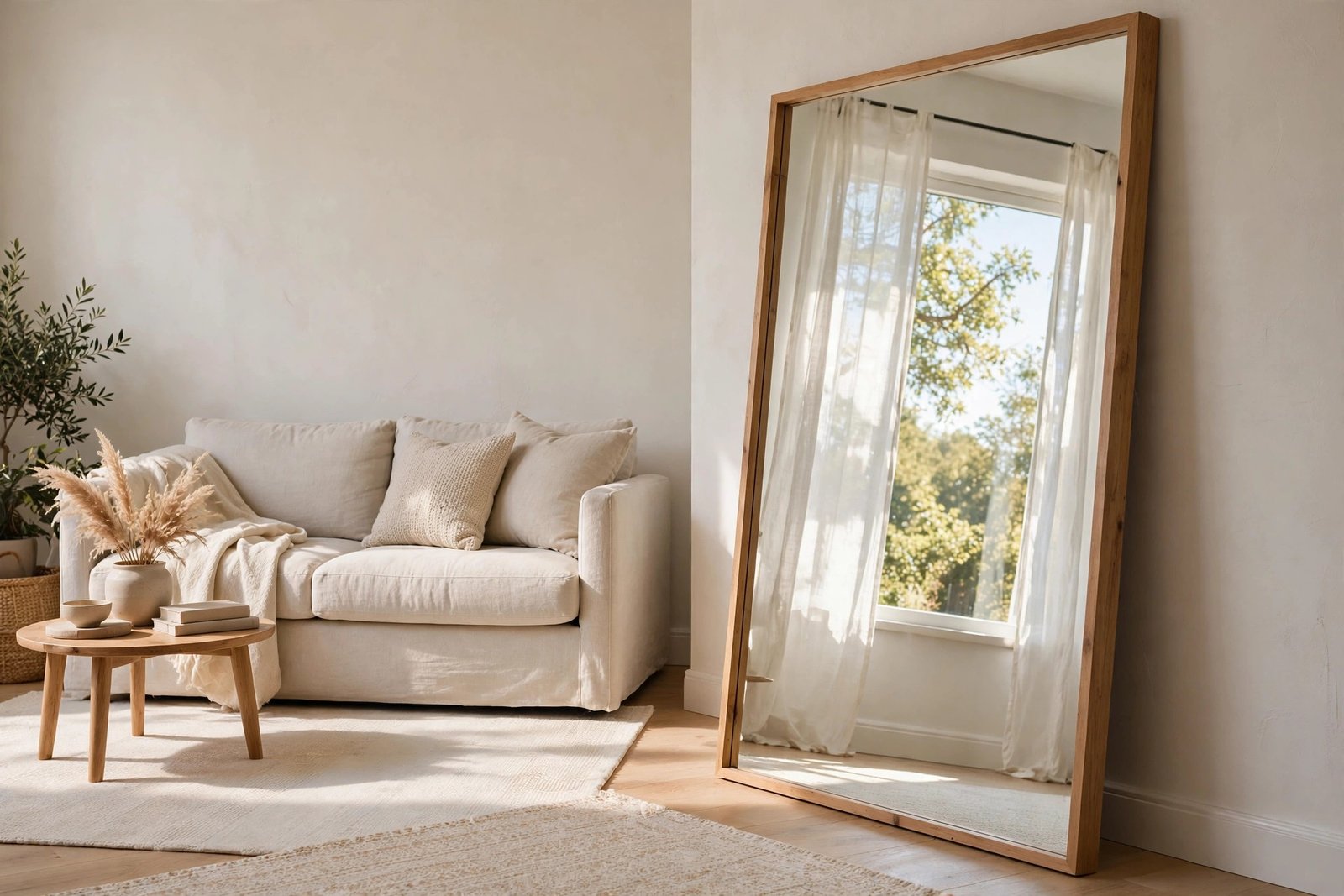
A gallery of tiny mirrors reads as clutter. One large mirror — at least 30″×40″, ideally floor-leaning — doubles the visual space by reflecting light and the room itself. Place it opposite or adjacent to a window to bounce daylight deep into the room.
The sweet spot: a leaning floor mirror ($80–150) in a thin frame. It needs zero installation, which renters love, and it makes even a 10-foot-wide room feel twice as deep.
3. Choose One Large Rug Instead of a Small One
This is the most counterintuitive trick on the list: a bigger rug makes a small room feel larger. A tiny rug floating in the middle of the floor chops the room into pieces. A large rug (8’×10′ if you can swing it, 5’×8′ minimum) unifies the floor into one continuous surface, and your eye reads that as more space.
Rule of thumb: the front legs of your sofa and chairs should all sit on the rug. If the rug is too small for that, it’s too small for the room.
Cost: a decent 8’×10′ low-pile rug runs $150–300. Washable rugs (Ruggable-style) cost more upfront but survive small-space living.
4. Pick Furniture With Visible Legs
Bulky furniture that sits flat on the floor looks like a solid block — your eye stops at it. Furniture on legs lets you see floor underneath, and visible floor reads as open space. Mid-century-style sofas, armchairs with tapered wooden legs, and coffee tables on slim legs all do this.
This single swap — a leggy sofa instead of a skirted one — can visually “give back” 6–8 inches of floor around every piece. In a small room, that’s enormous.
5. Go Monochromatic With Your Palette
A room decorated in one color family with tonal variation (creams, beiges, soft grays, warm whites) feels calm and continuous. Every time your eye hits a high-contrast color jump, it registers a boundary — and boundaries make rooms feel smaller.
This doesn’t mean beige boredom. Layer textures within the palette: a nubby cream throw, a linen-look sofa, a jute rug, matte ceramics. Same color family, tons of visual interest, zero visual clutter.
6. Float Furniture Away From Walls
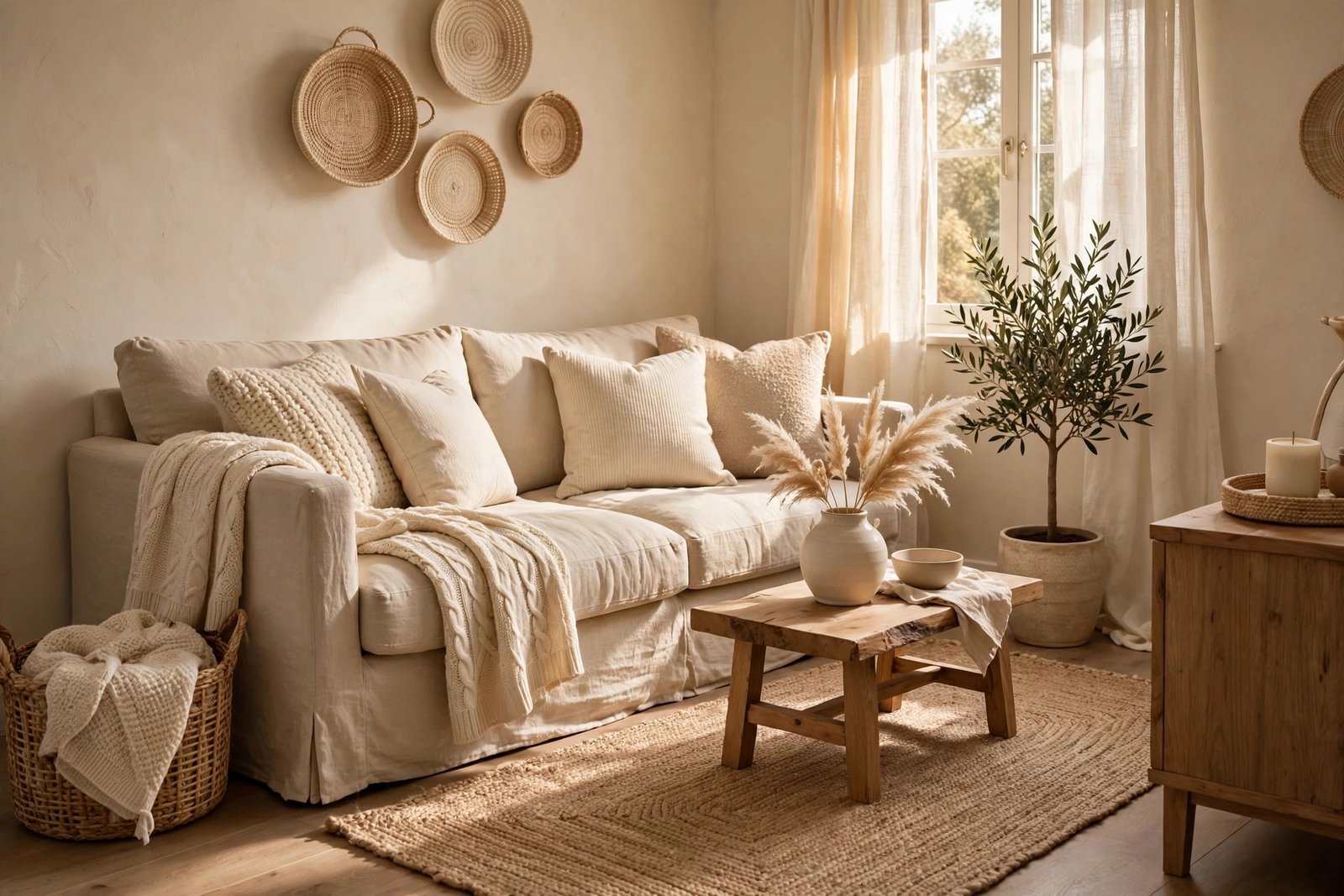
Pushing everything against the walls feels logical, but it creates a dead zone in the middle and makes the room feel like a waiting area. Pull the sofa even 3–4 inches off the wall and angle one chair slightly, and the room gains depth and intention.
In very small rooms, floating the sofa to face the room’s focal point (window, fireplace, TV) with a narrow console behind it creates a walkway and a sense of layers. It feels designed, not cramped.
Tip: If you can’t float the sofa, at least pull the coffee table 14–18 inches from the sofa instead of shoving it against the legs. Breathing room between pieces reads as square footage.
7. Use Vertical Space for Storage and Decor
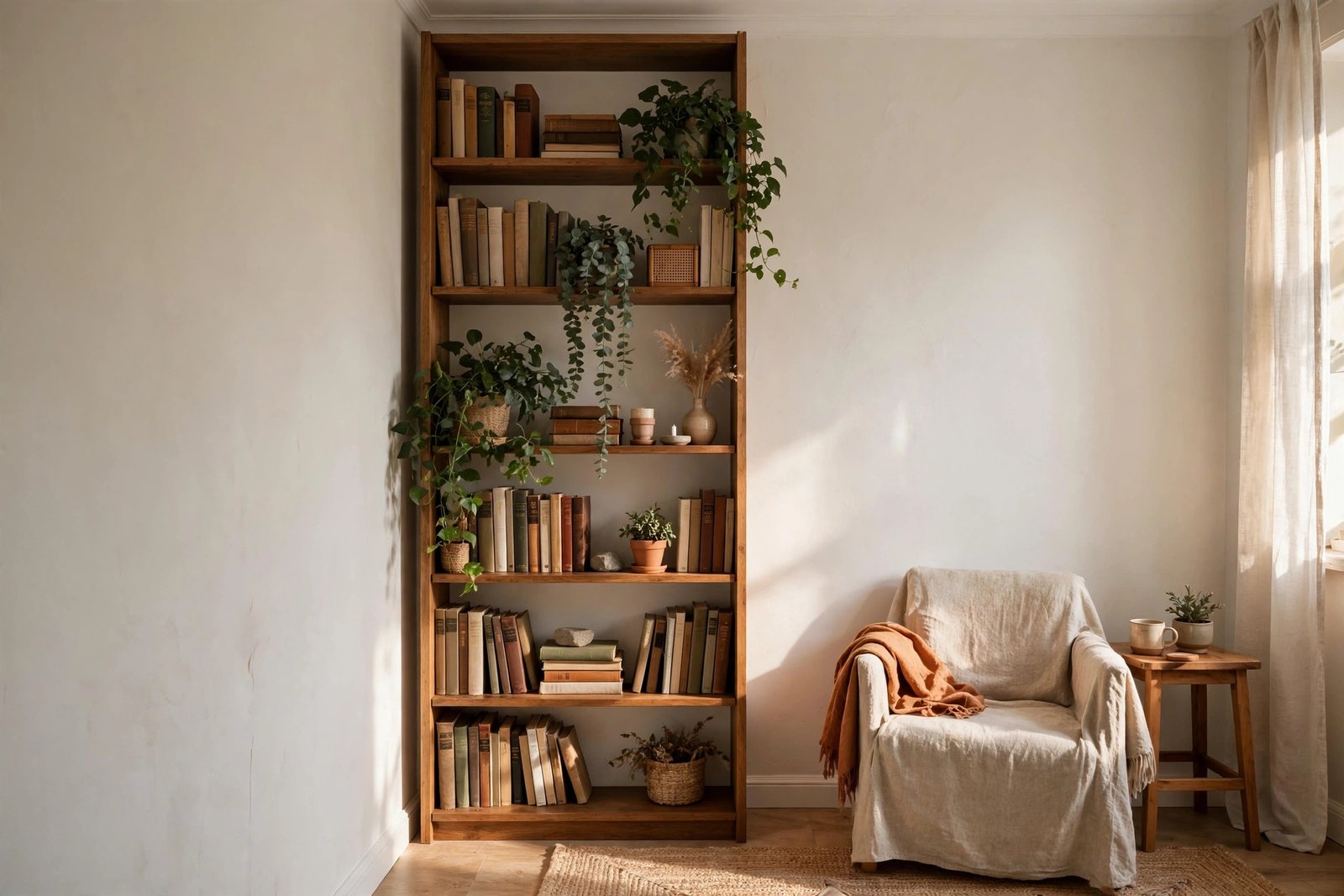
Small living rooms run out of floor fast — so go up. Tall, narrow bookcases, floating shelves near the ceiling, and wall-mounted cabinets draw the eye upward, which makes ceilings feel higher and floors feel less crowded.
A tall bookcase styled with the designer shelf formulas (rule of thirds, 60-30-10) does double duty: storage and a focal point that adds height to the room. Keep the top shelf slightly airy so the eye travels all the way up.
8. Layer Lighting at Three Heights
One overhead light flattens a small room and creates harsh shadows in corners — shadows that read as “the room ends here.” Layer light at three heights instead: a floor lamp in a dark corner, a table lamp on a side table, and the overhead on a dimmer.
Warm bulbs (2700K–3000K) everywhere. The goal is no dark corners: every corner that glows feels like more room.
Cost: a decent arc or tripod floor lamp runs $60–120; table lamps $25–50. This is one of the highest-impact-per-dollar upgrades on this list.
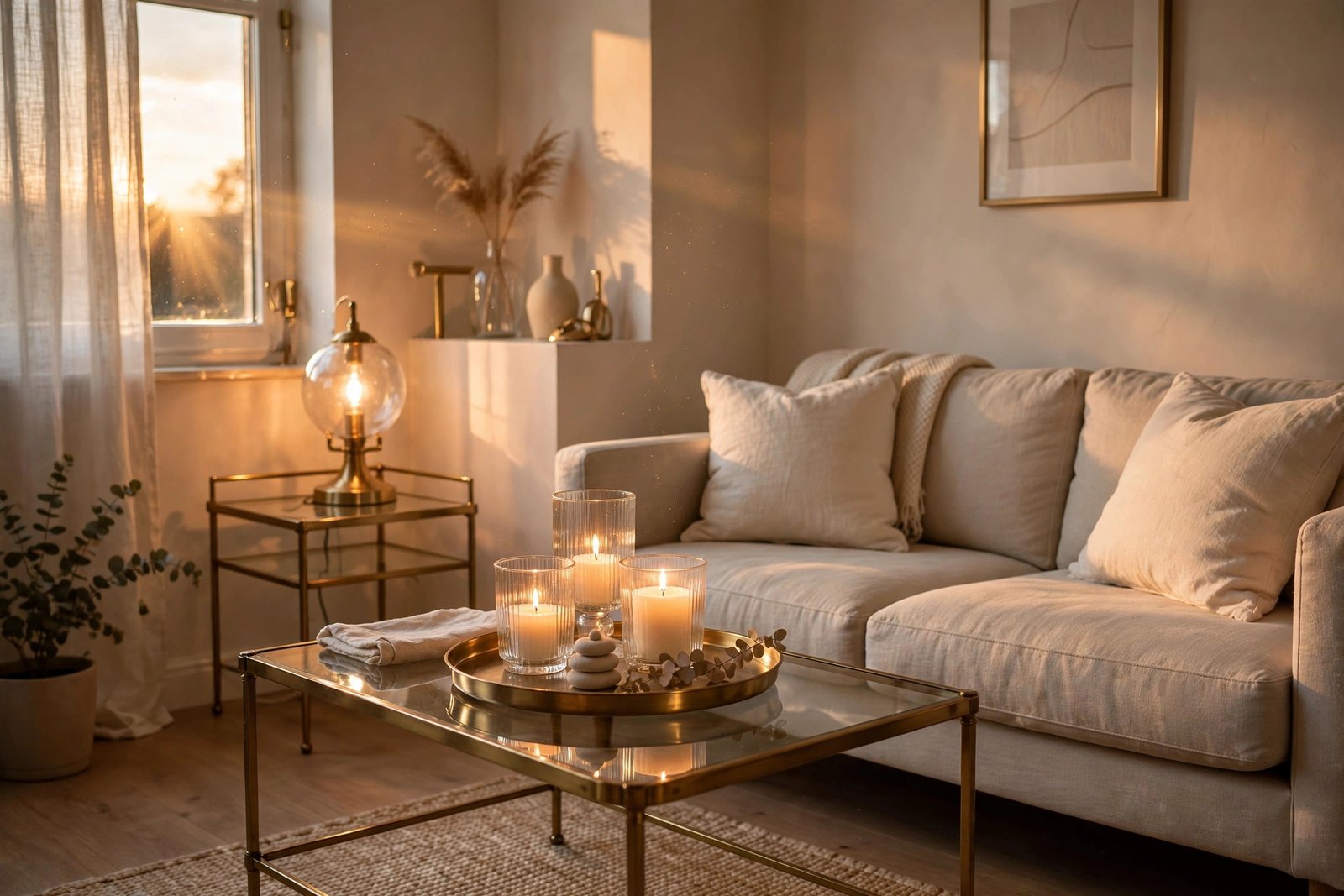
9. Choose a Glass or Lucite Coffee Table
A solid wood coffee table is a visual roadblock in the middle of the room. Glass-top or acrylic (lucite) tables practically disappear — you see the rug and floor straight through them, so the room reads as one open surface.
If glass feels too cold, a light-wood table with an open lower shelf (not a solid base) gets you 80% of the effect. The principle: the more floor you can see through and under furniture, the bigger the room feels.
10. Hang Curtains High and Wide
Curtains hung at the exact window frame make windows look small — and small windows make small rooms. Mount the rod 4–6 inches above the frame and 6–10 inches wider on each side, then use curtains that just kiss the floor.
The window now reads as much larger, the walls look taller, and the whole room gains grandeur. Use light, airy fabrics (linen-look, sheer) so daylight floods in.
Cost: a basic curtain rod ($15–25) plus two linen-look panels ($30–60). Under $100 for one of the biggest visual upgrades possible.
11. Keep the Coffee Table Styled, Not Stocked
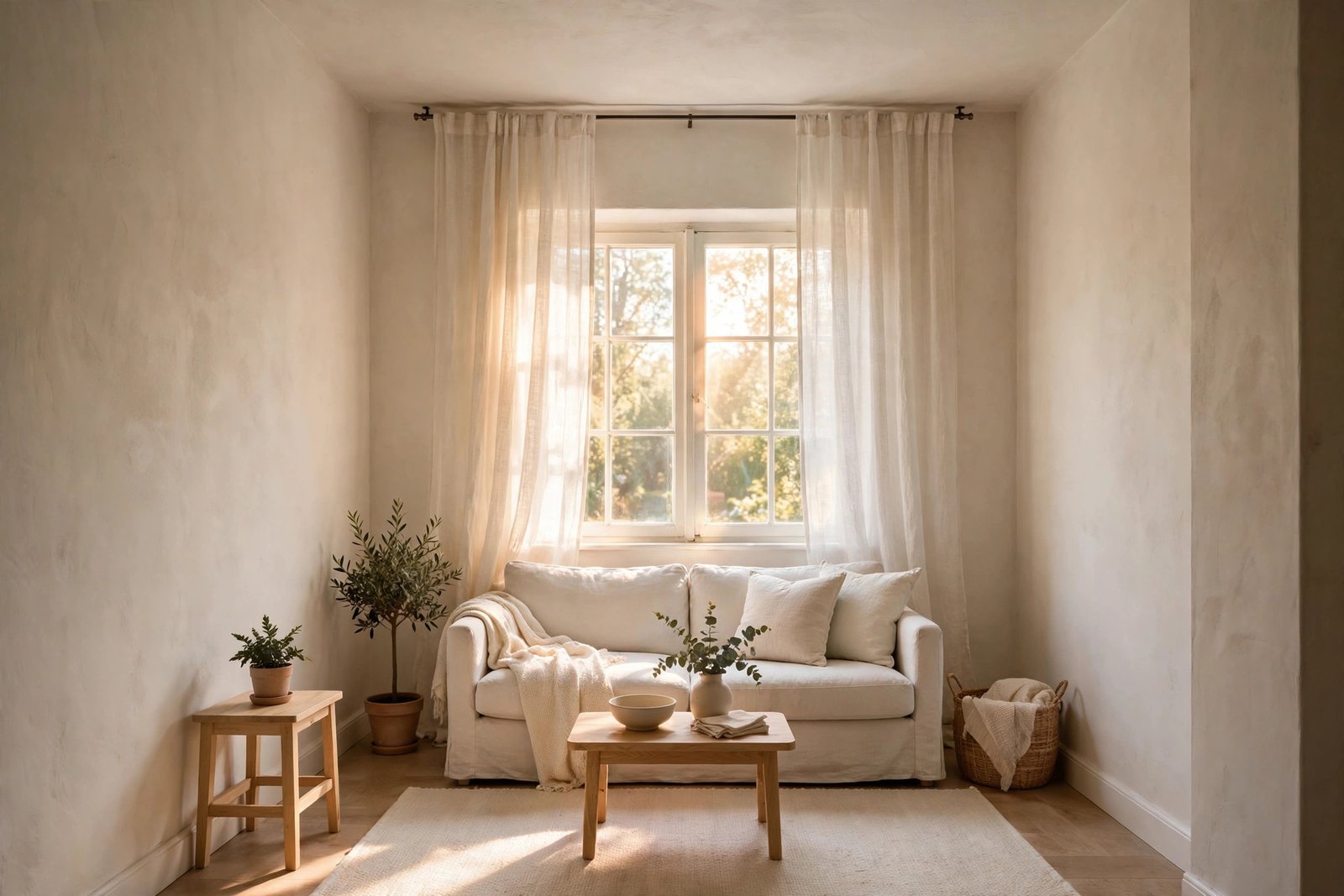
A coffee table buried under remotes, mail, and mugs is visual noise — and noise shrinks rooms. Style it with the rule of three: one stack of books, one small plant or object, one tray to corral the practical stuff.
The tray is the secret weapon. Remotes and coasters live in the tray, so the table still looks styled even when it’s in use. Corralled clutter doesn’t register as clutter.
12. Add One Statement Plant — Big, Not Many
Five tiny plants scattered around read as clutter. One large plant (4–5 feet tall) in a corner adds life, height, and a focal point without visual fragmentation. A fiddle-leaf fig, olive tree, or tall snake plant draws the eye up and fills an awkward corner beautifully.
No green thumb? A good faux olive tree ($60–100) fools everyone from six feet away and never drops a leaf on your rug.
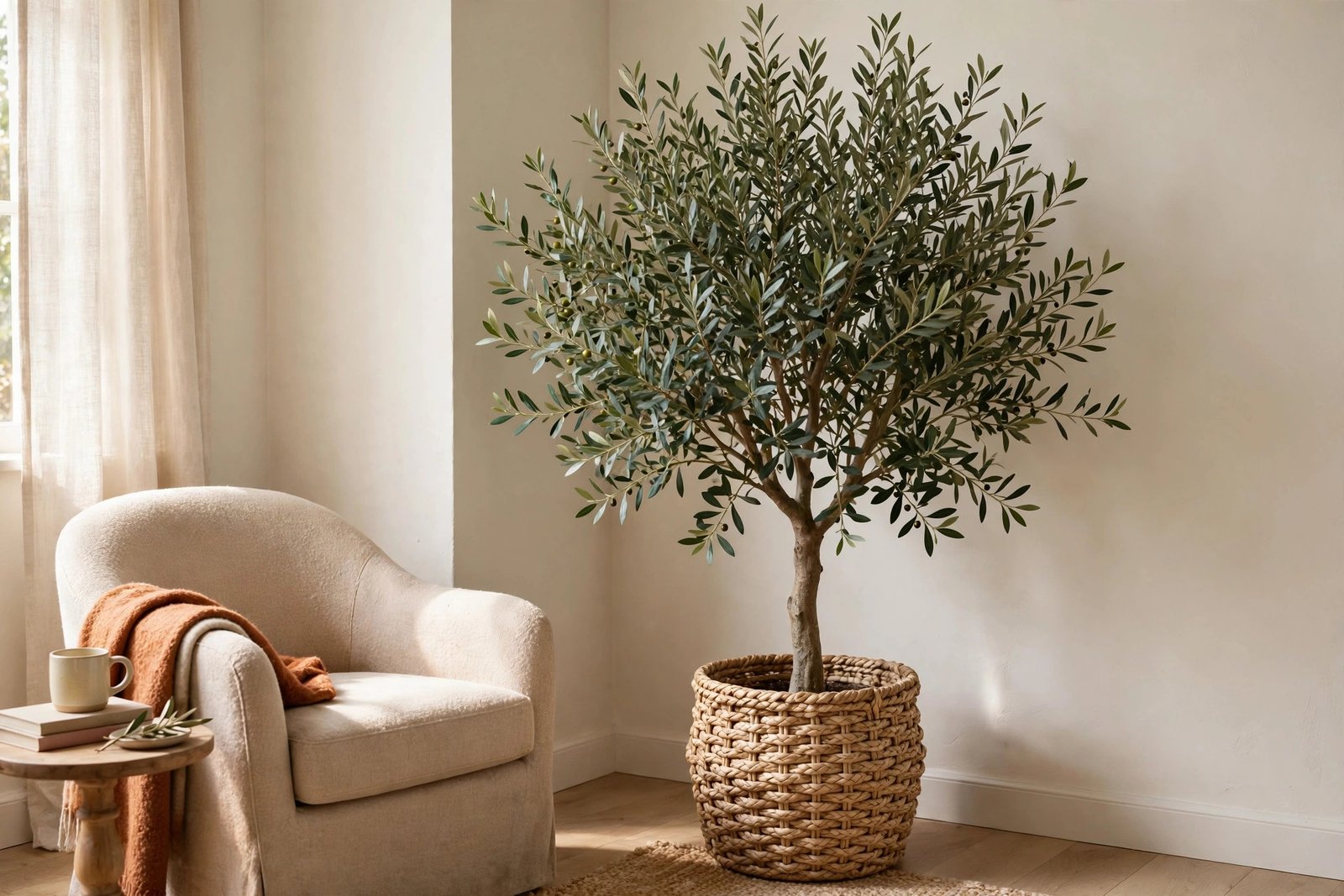
13. Carve Out a Reading Corner (Even a Tiny One)
A small living room doesn’t have to be only a TV room. One armchair, a floor lamp, and a small side table in a corner creates a reading nook that makes the room feel layered and purposeful — like it has rooms within the room.
This pairs beautifully with a styled bookshelf nearby: chair, lamp, books within arm’s reach. If you want the full formula, here’s how to build a cozy reading corner in any small space.
14. Use Multi-Functional Furniture Ruthlessly
In a small living room, every piece should earn its footprint twice. The classics:
- Storage ottoman ($60–120): footrest + coffee table (with a tray) + blanket storage.
- Sofa bed or daybed ($400–900): seating by day, guest bed by night.
- Nesting side tables ($50–90): one table most days, two when guests come.
- Drop-leaf console ($100–200): slim console normally, dining table when needed.
The takeaway: if a piece of furniture only does one job in a small living room, it needs to be exceptional at that job — otherwise replace it with something that multitasks.
15. Declutter Surfaces Weekly (The Free Fix)
No decor trick survives clutter. A 10-minute weekly reset — everything back in its home, surfaces wiped — does more for spaciousness than any purchase. Small rooms show mess faster because there’s nowhere for it to hide.
Build the habit into the room’s design: a lidded basket by the sofa for throws, a tray on the coffee table for remotes, one drawer (not five surfaces) for the miscellany. When everything has a home, the room stays feeling big.
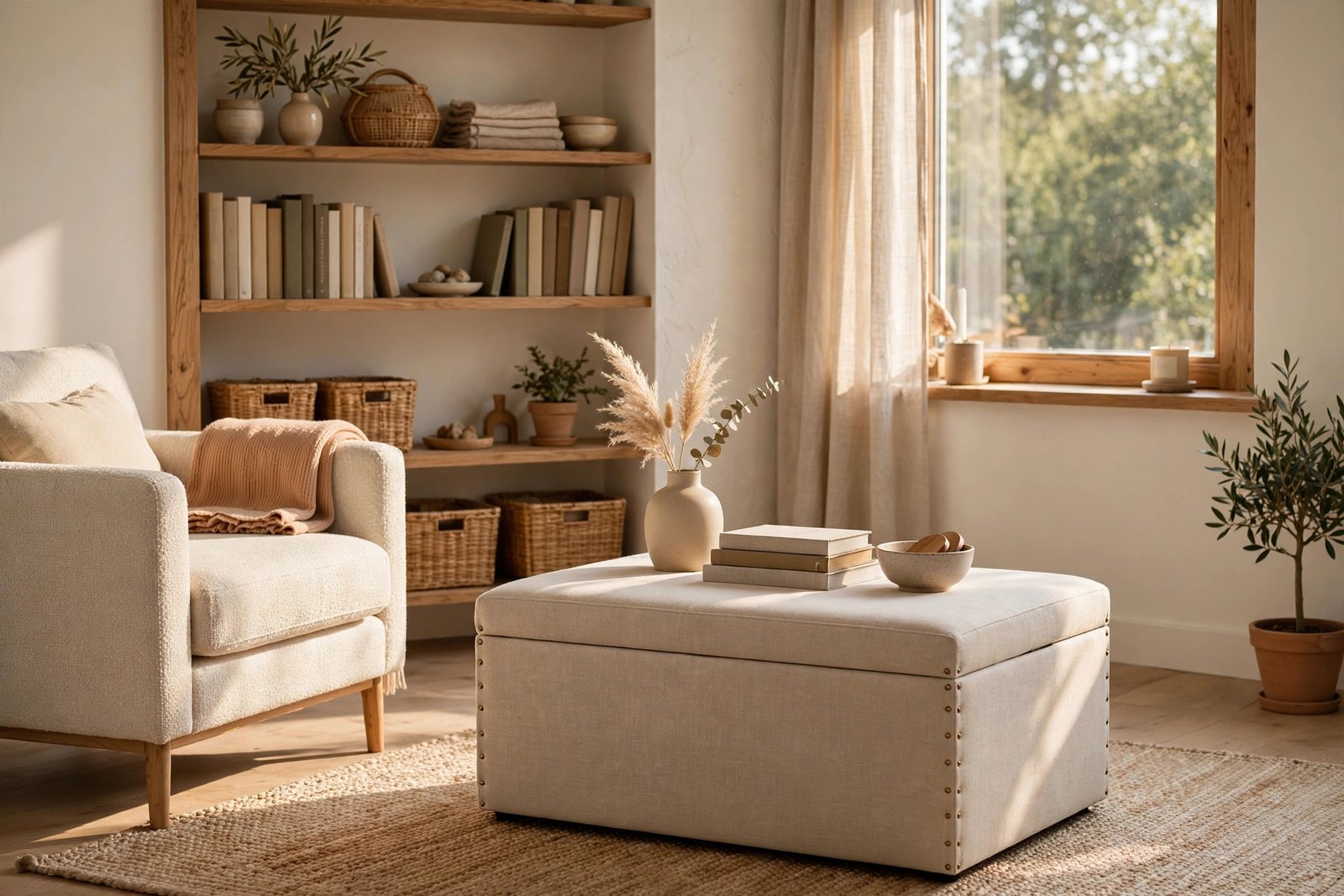
16. Choose Low-Profile Furniture
Tall, bulky furniture (high-back sofas, towering entertainment centers) eats vertical space and makes ceilings feel low. Low-profile pieces — a sofa with a low back, a media console instead of a tall unit, low bookshelves — keep sightlines open across the room.
When you can see over your furniture to the far wall, the room feels deep. When furniture blocks your sightline at sitting height, the room feels boxed in. It’s that simple.
17. Add Reflective and Metallic Accents
Beyond the big mirror: small reflective surfaces bounce light around the room. A brass tray, a mirrored side table, glass candle holders, metallic picture frames — each one catches light and throws it into corners.
You don’t need much. Three to five metallic or glass accents, distributed around the room, create a subtle shimmer that makes the whole space feel brighter and more open. Think jewelry for the room: small, strategic, high-impact.
Quick Comparison: Biggest Impact per Dollar
| Idea | Visual impact | Typical cost | Renter-friendly? |
|---|---|---|---|
| Large mirror | ★★★★★ | $80–150 | Yes (leaning) |
| Bigger rug | ★★★★★ | $150–300 | Yes |
| Curtains hung high & wide | ★★★★☆ | $45–85 | Yes |
| Light paint / peel-and-stick | ★★★★☆ | $35–55 | Yes (peel-and-stick) |
| Layered lighting | ★★★★☆ | $85–170 | Yes |
| Leggy furniture | ★★★★☆ | $0–400+ | Yes |
| Monochromatic palette | ★★★☆☆ | $0–100 | Yes |
| Glass coffee table | ★★★☆☆ | $80–180 | Yes |
| Vertical storage | ★★★☆☆ | $40–120 | Mostly |
| Declutter routine | ★★★☆☆ | Free | Yes |
Notice: the top three impact-per-dollar moves are all under $300 combined if you shop smart — and two of them are fully renter-friendly.
Frequently Asked Questions
How do I make a small living room look bigger?
Work the big three: light (pale walls, layered warm lighting, no dark corners), scale (one large rug, one large mirror, furniture with visible legs), and continuity (monochromatic palette, clear surfaces). These three categories cover 80% of the perceived spaciousness. The remaining 20% is decluttering — a tidy small room always feels bigger than a messy large one.
What size rug for a small living room?
Bigger than you think. Minimum 5’×8′, ideally 8’×10′ — the front legs of the sofa and all chairs should sit on it. A rug that’s too small chops the floor into pieces and makes the room feel smaller. If 8’×10′ feels like a lot of rug, remember: it’s covering floor you’d otherwise see as separate fragments. One continuous surface reads as one bigger room.
What colors make a small living room feel larger?
Warm off-whites, pale greige, soft cream, and light warm grays — colors that reflect light without feeling sterile. Keep the palette monochromatic (one color family, tonal variation) so the eye travels without hitting boundaries. Add depth through texture rather than contrasting colors: linen, jute, nubby wool, matte ceramics in the same family.
How do I arrange furniture in a tiny living room?
Start with the focal point (window, fireplace, or TV wall), place the sofa facing it — even 3–4 inches off the wall — then angle one chair to create conversation, not a lineup. Keep walkways 30+ inches where possible. Float what you can, keep sightlines open over low-profile pieces, and resist pushing everything flat against the walls; a little breathing room between furniture and walls paradoxically makes the room feel larger.
Can I fit a sectional in a small living room?
Sometimes — but measure ruthlessly first. A small-scale sectional (under 90″ wide) with a reversible chaise and visible legs can work in a 12’×14′ room, and it seats more people than a sofa + chair combo. The danger is a bulky, overstuffed sectional that eats the room: low arms, tight back, light color, legs visible. If the sectional would block walkways or force furniture against every wall, stick with a loveseat + accent chairs instead.
Final Thought
Here’s the truth about small living rooms: they don’t need less decor — they need smarter decor. Every idea on this list works because it gives your eye what it’s looking for: light to follow, lines that continue instead of stopping, and surfaces that breathe.
Start with the mirror and the rug. Those two alone will change how the room feels by tonight. Then layer in the rest one weekend at a time — and enjoy the strange, wonderful moment when guests ask if you knocked down a wall.
You didn’t. You just decorated like the room was bigger. Now it is.

11 Comments